Compass360: Smart Compass tool
- 3.5
- Rating
- 1.00M
- Installs
- Free
- Price

 Analysis by App-foxy
Compass360: Smart Compass tool is the kind of weather app that catches my attention quickly because it combines two jobs that are usually kept separate: finding direction and checking conditions outside. I tested it with that practical question in mind: does the combination become useful enough to keep on my phone, or does it feel like a novelty after the first few days?
My short answer is that it can earn a place on a phone for people who regularly need a simple compass and prefer weather information in the same app. It is free, rated for Everyone, and developed by Avn Global Application, so the barrier to trying it is low. The more important question is whether its day-to-day usefulness matches what you personally expect from a dedicated weather service or a dedicated navigation tool.
The app is currently at version 1.2.2 and works on Android 7.0 or later. That broad compatibility makes it accessible to people using older phones, although the experience naturally depends on the device’s sensors and the way its screen presents information. I would treat it as a convenient pocket tool rather than a replacement for a full navigation system or a specialized severe-weather service.
You May Also Like

 Blood Strike: 2.5 Anniversary
Blood Strike’s Loadouts Turn Every Drop Into a Tactical Gamble
A close look at Blood Strike’s custom loadouts: how fast access to signature weapons reshapes its battle royale rhythm, rewards preparation, and narrows the gap between fights.

 Pandora - Music & Podcasts
Pandora’s Music Is Easy to Start, but Harder to Recover
Pandora’s strength is its low-effort path from a seed to a station. Its weak spot is how much confidence it asks you to place in connection, setup, and quiet recovery.

 8 Ball Pool
 Is Built on Rivalries, Rematches, and Routine
A close look at the rivalries, rematches, shared routines, and unanswered safety questions that turn a quick pool match into a persistent mobile community.

 Samsung Music
’s Quiet Strength Is Playing What You Already Own
Its reach comes less from spectacle than from dependable access to a personal library. That simplicity is both the app’s strongest retention engine and its ceiling.

 AccuWeather: Weather Radar
AccuWeather Review: A Quick, Clear Forecast for Everyday Decisions
For everyday plans, the best forecast is the one you can understand quickly. AccuWeather makes rain timing, radar, and local conditions easy to act on, with a few trade-offs.

 Hill Climb Racing
Why Hill Climb Racing Still Turns Crashes Into One More Run
A tiny car, a bumpy hill and one more upgrade: Hill Climb Racing keeps resurfacing because its simple chaos makes every near-miss feel personal.
More From Our News Desk



From an appealing first week to a more practical routine
I find the shift from first-week curiosity to routine use is best judged by whether the two tools solve the same small problem for you, not simply whether both seem useful on their own. Try opening the app before a walk or outdoor errand, then notice whether checking direction and conditions together actually saves a step. That practical test leads naturally to what has—and has not—changed in its current form.
Why the first impression is easy to like
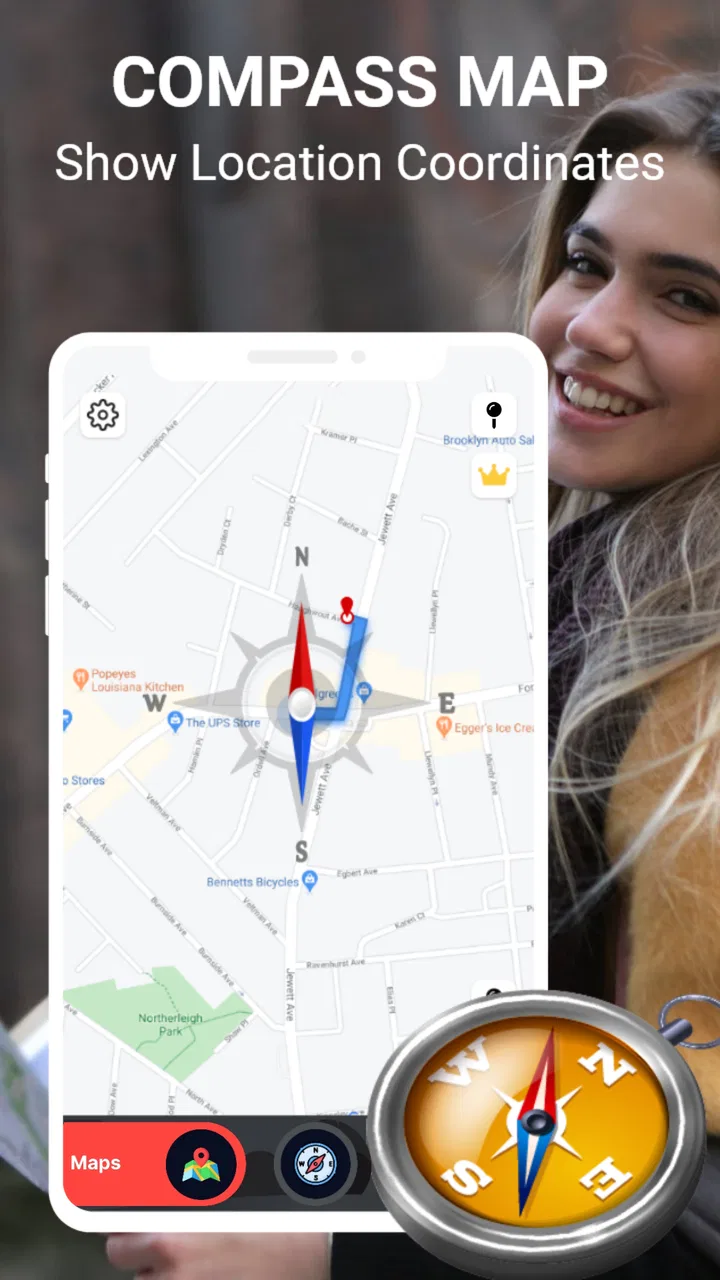
The attraction is immediate: a magnetic compass is useful in situations where a map feels excessive, while weather alerts can influence what you do next. If I am leaving home for a walk, checking a campsite, orienting myself in an unfamiliar neighborhood, or simply trying to understand which way I am facing, having directional information and weather awareness together feels more natural than opening several unrelated tools.
The store summary describes the app as a meeting point between magnetic direction and smart technology, and that idea is more meaningful in real use than it first sounds. Direction tells me where I am facing; weather context helps me decide whether continuing in that direction makes sense. That connection is especially convenient when I am outside and want a quick answer rather than a long forecast session.
During the first week, I would expect the compass side to receive most of the attention. It is easy to open the app just to test the heading, turn the phone in different directions, and see how quickly the display responds. That first interaction has a small element of discovery because the phone becomes a physical instrument rather than just another screen full of forecast cards.
The weather side gives the app a second reason to return. Weather alerts are more useful when they are connected to a decision: whether to leave now, take another route, postpone an outdoor task, or bring another layer. I found that this is the strongest argument for the combined design. The app is not merely showing two unrelated panels; it can support a short outdoor planning habit.
A realistic everyday scenario
Imagine I am heading to a park after work. Before leaving, I open Compass360, check the current direction to orient myself toward a trail or meeting point, and look for weather information that might affect the walk. If an alert appears, I can reconsider the timing instead of discovering a change only after arriving. Once I am outside, the compass remains useful when phone maps would be unnecessarily detailed.
That scenario sounds simple, but simple is precisely where this app makes sense. I do not always need turn-by-turn navigation, saved routes, traffic information, or a complex radar view. Sometimes I only need a directional reference and a warning that the conditions may change. For those short decisions, the combined approach can reduce the number of apps I open.
There is also a useful social angle. If I am helping someone orient a room, checking a campsite layout, explaining where the sun will set relative to a location, or finding a general direction in a new place, a compass is faster than building a route. The weather component adds value when the activity is outdoors and time-sensitive.
What the app is not trying to replace
I would not use this app as my only source for serious travel planning. A conventional weather service is usually better when I need a detailed forecast timeline, long-range planning, radar interpretation, or information from a service I already trust. Likewise, a map application remains the better choice for addresses, walking routes, public transport, and precise navigation.
The compass also should not be treated as a professional navigation instrument. Phone compasses depend on the device’s magnetometer and can be affected by nearby metal, electronics, or poor calibration. That is not a flaw unique to Compass360, but it is an important practical limit. If the reading seems unstable, I would move away from a vehicle, magnetic accessory, or crowded electronic environment before relying on it.
This distinction helps set reasonable expectations. Compass360 is most appealing when I want a lightweight outdoor utility, not when I need every possible weather layer or a complete navigation ecosystem. The app’s value comes from reducing friction for small tasks, not from replacing the most advanced tool in each category.
Small habits that make the combination more useful
One of my more useful habits would be checking the weather before using the compass for an outdoor activity, rather than opening the compass only after I am already outside. That order turns the app into a planning tool. I can decide whether the activity is worth starting, then use the directional display once I am moving.
A second practical habit is to use the compass for orientation, not distance. If I need to know which way a trail or building lies, it can help. If I need to know how far away it is or how to reach it safely, a map is more appropriate. Keeping those roles separate prevents the app from being judged against a function it was not designed to provide.
A third tip is to pause for a moment before trusting a heading. Holding the phone flat, away from obvious sources of interference, gives the sensor a fairer chance to settle. I would also avoid making a quick directional decision from a single glance if the display is moving noticeably. The best use is deliberate but brief: check, confirm, then continue.
How the first-week novelty changes
The novelty fades fairly quickly because a compass is not something most people inspect continuously. After the first few experiments, the app has to prove that its weather side creates recurring value. This is where the experience becomes more personal. Someone who walks, camps, gardens, travels locally, or works outdoors may open it often. Someone who spends most days indoors may only remember it when a specific need appears.
That is not necessarily a weakness. Utility apps do not need to be opened every day to be worthwhile. A tool can justify its space by being dependable when the right moment arrives. The question is whether the app is faster and more convenient for those moments than the separate compass and weather tools already on the phone.
Month-to-month value depends on repetition
After the first month, I would judge Compass360 less by how interesting it feels and more by whether it supports a repeatable routine. The strongest recurring use is likely to come from pairing it with activities that already happen regularly: morning walks, weekend outings, outdoor work, local trips, or checking conditions before a commute that includes time outside.
For me, the app would remain installed if I repeatedly used the compass and weather information in the same short session. That combination is the core test. If I only use the compass once every few months and always return to another weather app for alerts, the extra presence becomes harder to justify.
The app’s free price helps with that decision. I can try it without committing money, keep it through a few real situations, and remove it if it does not become part of my routine. Free access is particularly useful here because the app’s value is situational rather than universal. Its fit depends heavily on how often I need these specific tools together.
Who is likely to keep using it?
I think it suits casual outdoor users better than specialists. A person who wants a quick compass for walks, trips, orientation, or simple outdoor planning may appreciate the compact approach. It can also suit families because the Everyone content rating makes it appropriate for a broad audience, while the basic concept is easy to explain to someone who has never used a compass app.
It is also a reasonable option for people with older Android phones, since Android 7.0 is the minimum operating system. That does not guarantee identical performance on every device, but it means the app is not limited to recent hardware. For a spare phone or an older travel device, that wider compatibility can matter.
I would be more cautious if my main requirement is detailed meteorological information. In that case, a dedicated weather app with the exact forecast views and alert controls I prefer may be a better long-term choice. I would also choose a dedicated navigation app for driving, walking directions, route recording, or location sharing. Compass360 works best as a focused companion, not as an all-purpose replacement.
The maintenance burden is low, but not zero
There is little ongoing maintenance in the traditional sense. I do not need to build a library, organize routes, or create a complicated profile just to use the basic idea of the app. That simplicity supports its role as an occasional tool. I can open it when needed rather than managing it as a major daily service.
Still, sensor-based tools benefit from sensible care. If the compass behaves strangely, I would first change my surroundings and check how I am holding the phone before blaming the app. A magnetic car mount, metal table, or nearby electronic equipment can make a reading less trustworthy. This is a small but important part of using any phone compass responsibly.
Weather alerts also deserve attention. An alert is useful only if I notice it and understand what action it should influence. I would not let a notification alone determine a risky outdoor decision. For important plans, I would compare the information with another trusted source, especially when conditions could change quickly or safety is involved.
The current version, 1.2.2, suggests that the app is being maintained as a working product, but a version number by itself does not tell me how frequently I will see meaningful improvements. From a user perspective, the ideal maintenance pattern is invisible: the compass remains responsive, weather information stays useful, and the app does not make a simple check feel like a chore.
Where long-term fatigue can appear
The biggest source of fatigue is repetition without added usefulness. If every opening feels like the same compass screen and I rarely need weather alerts, the combined concept may stop feeling special. This is the central long-term trade-off: combining two tools saves switching, but it does not automatically make both tools equally valuable to every person.
Another possible frustration is the gap between a quick weather alert and the detail needed to act confidently. An alert can tell me that I should pay attention, but I may still want a fuller forecast before planning a long outing. When that happens, switching to a dedicated weather service is not a failure; it is the sensible next step.
There is also a learning curve around trusting the compass. New users may assume that the displayed heading is automatically precise. In practice, the phone needs to be held properly and used away from interference. If the app does not immediately give a stable reading in a particular environment, that can undermine confidence even when the underlying limitation comes from the hardware and surroundings.
For some people, the app may feel like an unnecessary duplicate. Most Android phones already include some form of weather access, and compass functions can be available through other tools. The reason to keep Compass360 would therefore be convenience and preference, not a lack of alternatives. I would keep it only if its combined presentation makes my routine quicker.
Comparing it with the usual alternatives
Compared with a standard weather app, Compass360 has a clearer outdoor-instrument identity. A dedicated weather app normally wins for forecast depth and repeated weather checking, while Compass360 offers a more immediate directional function alongside weather awareness. If I am deciding what to wear for the next several days, I would lean toward the specialist. If I am stepping outside and want orientation plus a quick condition check, the combined app is more appealing.
Compared with a standalone compass app, Compass360 has the advantage of context. I do not have to open one tool for direction and another for weather alerts. The trade-off is that someone who only needs a compass may prefer the most minimal interface possible. In that case, the extra weather role may add little.
Compared with a map application, Compass360 is lighter and less distracting for basic orientation. Maps are superior when the destination, route, or distance matters. The compass is superior when I already know roughly where I am going and simply need to establish direction. Choosing between them depends on whether the task is orientation or navigation.
This comparison also explains why I see the app as a companion rather than a universal solution. Its best advantage is not that it beats every alternative at every task. It is that it brings two relevant outdoor checks into one quick interaction for users who value that pairing.
What the public response suggests
Compass360 has passed one million installs, which shows that the concept has reached a substantial audience. Its average rating is 3.2 from around 579 ratings, with 17 written reviews. I would read that as a reason to try the app personally rather than assume it will satisfy everyone. The reach is encouraging, but the middling average suggests that expectations and real-world experiences are not identical for all users.
For me, the rating reinforces the need to test the app in the places where I would actually use it. A compass that feels fine at home may behave differently near a car or metal furniture. Weather usefulness also depends on whether the information arrives at the right time for my routine. A short, realistic trial is more informative than judging the app only from its store summary.
My long-term verdict
I would recommend Compass360 to a friend who wants a free, approachable outdoor utility that joins a magnetic compass with weather awareness. It is particularly suitable for casual walks, local trips, simple orientation, and people who like checking conditions before heading outside. The broad age rating and support for Android 7.0 or later make it an easy app to consider across a range of devices.
Its lasting value comes from the connection between direction and decision-making, not from the novelty of seeing a compass on a phone. If that pairing saves me from switching between apps several times a week, it earns its place. If I only want detailed forecasts, a dedicated weather app will probably serve me better. If I need routes or dependable navigation, I should use maps instead.
My final view is positive but selective. I like the practical idea, the free entry point, and the way it can support short outdoor decisions without the weight of a full navigation system. I would not keep it simply because it is interesting during the first week. I would keep it if my habits included regular outdoor checks and the combined workflow stayed faster than my usual alternatives.
That makes Compass360: Smart Compass tool a useful niche app rather than an essential installation for everyone. It earns lasting space when it becomes part of a real routine: check the conditions, orient yourself, and move on. For users whose days rarely involve either task, the app will likely remain an occasional curiosity, and that is a fair reason to skip it.
FAQs for Compass360: Smart Compass tool
01What features does Compass360 offer compared to other compass apps?
Compass360 provides a highly accurate digital compass experience with additional features like GPS integration, offline mode, and customizable interface options. Unlike many other compass apps, it also includes a magnetic declination correction, ensuring precise navigation even in areas with magnetic interference. It’s designed for both casual users and travelers who need reliable orientation tools.
02Is Compass360 suitable for use in remote areas without internet access?
Yes, Compass360 is fully functional in offline mode. The app is designed to work without an internet connection, making it ideal for hiking and exploring remote areas. While some features like map integration require connectivity, the core compass functionality remains accurate due to its reliance on the device's built-in sensors.
03How accurate is the Compass360 app, and what factors can affect its performance?
The accuracy of Compass360 is generally high, but it can be influenced by factors such as magnetic interference from nearby electronic devices or metal objects. The app includes a magnetic declination correction feature to enhance precision. Regular calibration, as prompted by the app, helps maintain optimal performance.
04Does Compass360 drain the phone’s battery quickly when in use?
Compass360 is optimized for low power consumption and should not significantly drain your phone’s battery during regular use. However, using GPS and other location services can increase battery usage. It's advisable to close the app when not in use and adjust settings to minimize battery impact during extended outdoor activities.
05Is Compass360 user-friendly for beginners who have never used a compass app before?
Absolutely, Compass360 is designed with an intuitive user interface that is easy to navigate, even for beginners. The app includes a helpful tutorial and tooltips to guide new users through its features. With its straightforward design and clear instructions, it’s suitable for anyone needing a reliable compass tool.
Pros
- Accurate direction readings
- User-friendly interface
- No internet required
- Lightweight app size
- Customizable settings
Cons
- Ads can be intrusive
- Limited advanced features
- Occasional calibration needed
- No night mode
- Minimal support for tablets

Compass360: Smart Compass tool
Gallery